Mid-century ceramic pioneer Laura Andreson spotlighted in long-overdue Los Angeles retrospective
Art Daily
October 13, 2026
LOS ANGELES, CA.- Laura Andreson was an inventive ceramicist and educator in the Los Angeles area from the 1930s through the 1980s whose influence is underrecognized. This exhibition brings to light her seminal impact on the Southern California clay movement, contemporary sculpture, and design, both as founder of the Ceramics program at UCLA and tireless innovator in ceramic forms and surfaces. Her contributions are especially noteworthy being during a time of extreme patriarchy in the worlds of both art and education.
More than forty pivotal examples of Andreson’s work will be exhibited alongside the work of some of her noteworthy students, such as JB Blunk, David Cressey, and Bernard Kester, as well as the work of Andreson’s own mentors and peers such as Gertrud and Otto Natzler, Marguerite Wildenhain, and Carlton Ball.
Andreson’s work is characterized by a subtle and nuanced understanding of volume and color, being representative of the finest in Abstract Expressionism from the mid-twentieth century. Stylistically, she melded Scandinavian, Japanese, Bauhaus and other modernist sensibilities and instilled potent expression in the humble vessel form. Elements of the natural landscape and the palette of Southern California are echoed in her pieces. Andreson’s unwavering exploration of form, surface, texture and glaze, helped to give rise to the birth of studio ceramics as a contemporary art medium.
Like many of her peers who defied artistic hierarchies, Andreson straddled the worlds of craft, art, and design. Her work was uplifted by the groundbreaking California Design exhibitions that were organized by the Pasadena Art Museum. She was authentically at the forefront of Mid-Century Design as it emerged.
Andreson touched the lives of thousands of students over the course of her respected teaching career. Many have credited her with opening doorways for their own artistic explorations. Yet despite her significant influence, her expansive body of work has never been presented in a museum retrospective in Los Angeles, the very city where she lived and worked, only at the Mingei, in San Diego in 1982. Over four decades later, this exhibition spotlights her vision, illuminating how her work remains fresh, original, and relevant. Many Californian artists whose work embodies and builds on her teachings will also be represented. These artists, in turn, have passed on Andreson’s artistic views and approaches to subsequent generations of artists.
“Throughout the history of ceramics, taste and the standards of judgement appear to vary from one generation to the next. We should always, therefore, be inspired by the finest examples from all times and try to enjoy the qualities from every age that come from experimentation. To live in one’s generation is important, but in imitation, one’s work becomes lifeless. One’s own true feelings and character should be evident in the work produced. I hope my work expresses a sensitive, honest use of materials and techniques and that some of it will embody the eternal quality of aesthetic joy.”—Laura Andreson
True Gravity
The Architect’s Paper
10/13/26
Luminous forms welcome visitors to The Rockwell Museum, a Smithsonian Affiliate, in True Gravity, the latest installation in its Antigravity series. Created by neon artists and founders of She Bends Studios, the installation was designed by Kelsey Issel in collaborative mentorship with Meryl Pataky. The work will be on view through March 2027 in the first-floor entryway. Suspended within the Museum’s historic rotunda, the installation explores glass, light and the subtle forces that shape form.
She Bends is a neon organization and teaching studio dedicated to the practice and study of neon craft and contemporary art, highlighting the contributions of women and gender-expansive artists who bend their own glass and push the boundaries of the material.
“True Gravity is a study in balance: breath, heat and gravity conspiring with two artists to make something suspended between intent and inevitability—a record of trust in each other, in the material and in the invisible forces, human and natural, that hold us here,” said Issel.
Drawing from the visual and structural language of open weave textiles, True Gravity examines tensions between rigidity and flexibility and individuality and interdependence. Pataky and Issel’s neon creations invite visitors to reconsider the expressive potential of glass and light. Weighing more than 100 pounds, the soft glass tubes are filled with krypton, creating an ethereal milky white color suspended by monofilament.
The title of the work of art references Michael Murphy’s concept of “true gravity,” a condition in which the body yields to what the material and the environment already intend. The artists’ shared practice draws on feminist teaching methods, valuing attunement over control and exchange over hierarchy.
The presentation of “True Gravity” also supports America 250 as The Rockwell Museum’s contribution to “Handwork: Celebrating American Craft 2026,” a nationwide initiative led by Craft in America. The yearlong effort brings together makers, museums and cultural organizations to celebrate the craft traditions that connect communities across the country.
“During this year of celebrating American craft, the installation sets the tone for every visit to The Rockwell,” said Erin M. Coe, executive director of The Rockwell Museum. “True Gravity captures the experimentation at the heart of the Museum’s Antigravity projects, and Kelsey and Meryl’s boundary‑pushing neon offers a memorable and surprising experience for our visitors.”
Now in its eighth year, Antigravity is an ongoing series of site-specific installations in the entry of The Rockwell Museum. The program highlights emerging artists and invites them to create original, thought-provoking work in an unexpected space that greets every visitor. As the first artwork guests encounter, each installation is designed to be fun, surprising and engaging.
A key component of the Antigravity project is the Museum’s collaboration with the Corning Museum of Glass. Antigravity artists are invited to serve as guest designers in residence at the Amphitheater Hot Shop, where they work alongside expert glassblowers who help translate their ideas into glass. Pataky and Issel participated in this residency, using the opportunity to experiment with hot glassmaking techniques outside of their usual realm of work.
True Gravity is part of “Reframed at 50,” The Rockwell’s yearlong series of dynamic exhibitions and programs commemorating the institution’s 50th anniversary. The installation also coincides with the 2026 Glass Art Society Conference and the 75th anniversary of the Corning Museum of Glass.
Original post here.
Jennifer Ling Datchuk and Consuelo Jimenez Underwood: All That Before Us
Artsy
10/13/26
All that Before Us is rooted in intergenerational empowerment, lineage, and a shared reverence for materials; the unique connection between Datchuk and Jimenez Underwood underpins this exhibition.
Press Release
Ruiz-Healy Art is pleased to present All That Before Us: Jennifer Ling Datchuk and Consuelo Jimenez Underwood, a two-person exhibition at our New York City gallery. All That Before Us will be on view at our New York City gallery from September 10 to November 27, 2026. Employing time-honored craft techniques, Datchuk and Jimenez Underwood create work that uniquely balances fine art and technical skill. Their practice explores compelling themes such as migration, gender equality, and multicultural identity. Ruiz-Healy Art is proud to participate in Handwork: Celebrating American Craft 2026, a nationwide initiative led by Craft in America to honor the handmade during America’s Semiquincentennial. Through the exhibition, we join museums, artists, and organizations nationwide in celebrating craft traditions that connect us across history and time.
Rooted in intergenerational empowerment, lineage, and a shared reverence for materials, the unique connection between Datchuk and Jimenez Underwood underpins this exhibition. Datchuk presents a collection of ceramics and sculptures that invite viewers to look more closely at the frameworks surrounding the female and the labored body. Simultaneously, Jimenez Underwood presents a body of work that utilizes textile and sculptural components to explore and challenge systems that have built both human division and connection. Dismantling material hierarchies and championing the handmade are essential to the shared artistic language of Jimenez Underwood and Datchuk.
Consuelo Jimenez Underwood is the daughter of migrant agricultural workers, a Chicana mother, and a father of Huichol Indigenous descent. Her work reflects personal experiences and depicts the world through her tri-cultural lens. In the tradition of the rebozo textile in Mesoamerican Indigenous culture, Indigenous women were, in their own right, historic archivists. The rebozo was more than a shawl; it was a document of culture, history, and memory made of threadwork. An important motif in Jimenez Underwood’s work, the traditional importance of the rebozo is carried across time from a pre-colonial context into the modern world as a method of capturing contemporary culture. In Raining Barbed Wire Rebozo, the rebozo format combines with another of Jimenez Underwood’s motifs: barbed wire. In this work, the artist incorporates leather barbed wire, imbuing this rebozo with a complex oxymoron of texture and context. Often a shorthand for borders or human separation, barbed wire is woven into Rebozo’s threads, as though the artist has stepped into the role of an archivist documenting the division in our world today. She explains, “Empowered by the voices of my Indigenous maternal ancestors, I began to cross the intellectual borders that separated the hand and the mind (craft) from the spirit (fine art).”
Jennifer Ling Datchuk’s work explores the societal, cultural, and political systems women navigate through porcelain, adornment, blue and white patterns, reflective surfaces, and synthetic and human hair via installation, objects, and video. In juxtaposition, her pieces explore how relegation to the domestic, mother-sphere annihilates the innocence of girlhood and locks women into a controlled space of servitude. Datchuk uses race as a lens to narrow her demonstration of the circles Asian women in particular are allowed to operate within. Her work, Girl Fight, inspects not a brawl between two young women in the schoolyard but the internal fight that happens within oneself. No matter how empowered, no matter what women have attempted to reclaim, they still find themselves moving back and forth among choices dictated by outside patriarchal narratives. The two porcelain Song dynasty-inspired pot forms of Girl Fight are incised with chinoiserie imagery of Datchuk’s visual vocabulary – fertility figurines, aliens, bobby pins, maternal DNA structures, pregnancy tests, and combs. The internal fight is subject, the physical becomes object, and clay is body – the pot form and its shared language of the human form. Sprouting from the neck of the pots is Asian curly and straight human hair that comes together in one giant knot and depicts how dualities are complicated and very personal.
Throughout the exhibition, Datchuk and Jimenez Underwood reimagine traditional materials and time-honored forms, bridging gaps between the ancestral and the contemporary, exploring systems of power, and the nuances of identities within those systems. All That Before Us invites viewers to consider the movement of time, how we view the past, and how we allow it to inform the present.
Original post here.
ARTS AND HUMANITIES: Celebrating our country’s handicrafts
Aiken Standard
By Dr. Tom Mack
10/9/26
This year, there is one semiquincentennial observance that has slid under the radar in contrast to the more heavily publicized and sometimes controversial programs commemorating our nation’s 250th anniversary. “Handwork: Celebrating American Craft 2026” is a national initiative honoring our country’s craft traditions since its founding.
The Aiken County Historical Museum, for example, recently sponsored an exhibit titled “The Art of Needle and Thread,” featuring the stitchery of a host of local artisans. Our country’s craft traditions have long included skilled needlework.
Running until January of next year, “Body Matters” at the Columbia Museum of Art showcases an even greater variety of handcrafts, not only in fiber but also in wood, glass, ceramics and sweetgrass. All of the pieces in the current show make reference to their makers, either replicating the human body or offering evidence of the maker’s interaction with the made object.
Let’s examine three particularly noteworthy pieces representing three different media. In woodworking, there is no contemporary artist who matches the work of Bob Trotman of North Carolina. Harkening back to the days of ship’s figureheads and cigar store Indians, Trotman creates larger-than-life works that offer a wry commentary on contemporary life, particularly today’s social media-propelled obsession with self-image and the increasingly pronounced ravages of hyperbolic capitalism.
His 2008 “Person of Interest,” a large-scale bust of a male with receding hairline, comes with interchangeable mouths and pairs of eyes so that one can alter the figure’s expression to fit the occasion. It’s Trotman’s version of the police identikit, a composite picture created by combining facial features to fit the statement of a witness to a crime. In this case, however, it serves, as well, as a general reference to the faces we put on to face the world.
In addition to artists working in wood, the current exhibition includes those who make extraordinary objects from “dirt and water,” a phrase often used by artist Doug Jeck to describe his medium of choice, ceramics.
In the first gallery of this multi-gallery show is a prime example of what the late artist called his “human objects.” Titled “Figure in Transition,” this lifelike ceramic male sits on a low bench, his cupped hands resting on his knees, his brow furrowed in thought. The figure is undraped, vulnerable, inviting the spectator’s vicarious concern.
Textiles are also featured in the CMA’s current keynote exhibition. In this category no work is more imposing than the installation titled “Liminal Contact.” Engineered by Columbia-based artist Sheriden, this immersive piece composed of crocheted textiles is intended to replicate what the artist imagines to be the complicated interior spaces of the human body. Visitors are invited to navigate the twisting passageways between the suspended interlocking loops of yarn, dyed in the colors of blood and bone, that take up a whole gallery.
These three are among the roughly 70 crafted objects on display. “Body Matters,” a visual and tactile conversation between the body and material forms, is on view at the Columbia Museum of Art until Jan. 3.
Original article here.
Twentieth Century African American Quilts in California
Black Art in America
10/2/26

Routed West: Twentieth-Century
African American Quilts in California
A Story of Survival and Connection Told Through 80 Works by Black Quilt-Makers from the Second Great Migration to Today
At the National Museum of Women in the Arts
September 18, 2026–January 17, 2027
WASHINGTON—This fall, the National Museum of Women in the Arts (NMWA) presents an exhibition of more than 80 quilted objects that traces how Black women leaving the Jim Crow South stitched a legacy of survival, connection, and resilience across generations. On view from September 18, 2026, through January 17, 2027, Routed West: Twentieth-Century African American Quilts in California features works by more than 70 artists spanning 120 years. Exhibited on the East Coast for the first time, this must-see exhibition tells a uniquely American story through quilts from the Second Great Migration to today.
Sherry Ann Byrd (pieced 1990, Richmond, California) and Irene Bankhead (quilted 1990, Oakland, California), Cultural Merger at Crossroads, USA, 1990; Cotton, cotton/polyester blend, and rayon; hand-pieced and quilted; 95 x 75 ½ in.; Bequest of the Eli Leon Living Trust, BAMPFA; Courtesy of Sherry Ann Byrd; Photo by Kevin Candland
Organized by the Berkeley Art Museum and Pacific Film Archive (BAMPFA), where it debuted to strong acclaim in 2025, Routed West traces the flow and flourishing of quilts in the context of the Second Great Migration, a mass movement of approximately five million African Americans from the rural South to cities in the North and West between 1940 and 1970 in search of a more equitable life. Many of the hundreds of thousands who migrated to California carried quilts—not only for warmth and protection, but also as emblems of ancestral memory and cultural survival.
The quilts reflect their creators’ artistic and technical brilliance, resourcefulness, and legacy. Employing expert skills and often using found materials, such as tobacco pouches, denim, and work clothes, they disrupted and blurred boundaries between “craft” and “fine art.” Routed West also reveals the artistic legacy of quilting, a living language shared across generations from matriarchs who lived through the Civil War and Emancipation to contemporary artists. These textiles are cherished heirlooms that honor ancestors, pass down technical expertise, and stitch family bonds.
“NMWA invites audiences to see these quilt-makers not at the margins of art history, but as essential figures in the story of American art,” said NMWA Director Susan Fisher Sterling. “It is especially meaningful to bring this show to D.C., for its East Coast premiere. Black women artists transformed cloth into a language of experimentation, memory, and visual power. Routed West also advances our goal to challenge and disrupt gendered hierarchies, by positioning fiber arts as equally significant to traditionally venerated genres such as painting and sculpture.”
“Routed West threads the needle between Black people’s historical movements and their quilts to tell stories of collective care, resilience, and creative ingenuity,” said NMWA curator Orin Zahra, who organized NMWA’s presentation of the exhibition. “Underscoring the individual, family, and community-based stories of these quilt-makers, Routed West embodies NMWA’s commitment to sharing lesser-known stories and counternarratives about artists whose contributions to American culture are profound. As featured artist Sherry Ann Byrd said, ‘Quilt-makers are among the female warriors of yesterday, today, and tomorrow.’”
Hattie “Strawberry” Mitchell (Appliquéd and embroidered 1906–1908, 1914; Macon, Georgia; Quilted and finished ca. 1930; Macon, Georgia), Untitled (appliqué with embroidery), 1906–1930, Cotton; hand appliqué, hand piecing, hand quilted, 96 x 62 in.; Bequest of the Eli Leon Living Trust, BAMPFA
Exhibition Overview
Routed West is organized within five thematic sections. The quilts in Southern Roots highlight artistic approaches that reappear throughout the exhibition, such as the use of repurposed work clothes, improvisational piecing, pattern-based quilting, and tying. Hattie “Strawberry” Mitchell (1854–1942), one of the earliest quilt-makers in the exhibition, was born into slavery and spent her life laboring and working for white families. She quilted both for them and for personal use. After a transatlantic trip in 1906, Mitchell began working on a quilt of repeating green-and-red botanical forms patterned after leaves she collected while abroad, recording the locations of their origins with embroidery. Minnie Skinner (1920–2003) created a “britches quilt” in the late 1940s made of repurposed denim pieces, joining whole pant legs into a patchwork pattern.
Carried and Kept explores how quilts transcend their utilitarian purpose to become heirlooms and cherished objects. Many of the quilts in this section were brought to California by migrants from Arkansas, Louisiana, Mississippi, Oklahoma, and Texas. They offered literal and emotional protection, keeping them warm, preserving their southern roots, and anchoring their identity in a new landscape.
A hand-pieced quilt by Alice Neal (1916–1985) is a poignant tribute to her Louisiana-born mother, Mary Bright. Neal made the quilt in Oakland soon after her mother’s death in 1954, using leftover material from the dress Bright wore in the photo that inspired the quilt’s portrait. A replica of Bright’s hat snaps off to reveal a silk cap, and patterns carry personal meaning, such as the nine-block motif that was the first design Neal learned from her mother.
As teachers, nurses, seamstresses, truck drivers, grocery store managers, shipyard workers, and other members of a laboring class, artists in the section Rooted West used quilt-making to reclaim time for themselves, pursuing an activity that could be meditative, centering, and liberating. A 1991 quilt by Lily Chiles (1918–2000) features the continent of Africa and was created with her grandchildren. It affirms intergenerational care through a pan-African consciousness rooted in Oakland’s Black radical politics. As the elder quilter, Chiles guided her grandchildren in piecing and embroidering names of African countries onto the quilt. Isiadore Whitehead (1914–2005) was a school bus driver who quilted, and the school community donated fabric to help her create many projects, including the bedding, drapes, and pillows in an ambitious large-scale bedroom installation on view in the exhibition.
Exhibition Overview:
Routed West is organized within five thematic sections. The quilts in Southern Roots highlight artistic approaches that reappear throughout the exhibition, such as the use of repurposed work clothes, improvisational piecing, pattern-based quilting, and tying. Hattie “Strawberry” Mitchell (1854–1942), one of the earliest quilt-makers in the exhibition, was born into slavery and spent her life laboring and working for white families. She quilted both for them and for personal use. After a transatlantic trip in 1906, Mitchell began working on a quilt of repeating green-and-red botanical forms patterned after leaves she collected while abroad, recording the locations of their origins with embroidery. Minnie Skinner (1920–2003) created a “britches quilt” in the late 1940s made of repurposed denim pieces, joining whole pant legs into a patchwork pattern. Above (left): Gerstine Scott (Oakland, California), Untitled (Necktie quilt), 1989; Polyester, rayon, silk, wool, and other synthetic fabrics; hand-pieced and hand-quilted; 94 x 85 in.; Bequest of the Eli Leon Living Trust, BAMPFA; Courtesy of the Gerstine Scott Family
Carried and Kept explores how quilts transcend their utilitarian purpose to become heirlooms and cherished objects. Many of the quilts in this section were brought to California by migrants from Arkansas, Louisiana, Mississippi, Oklahoma, and Texas. They offered literal and emotional protection, keeping them warm, preserving their southern roots, and anchoring their identity in a new landscape.
A hand-pieced quilt by Alice Neal (1916–1985) is a poignant tribute to her Louisiana-born mother, Mary Bright. Neal made the quilt in Oakland soon after her mother’s death in 1954, using leftover material from the dress Bright wore in the photo that inspired the quilt’s portrait. A replica of Bright’s hat snaps off to reveal a silk cap, and patterns carry personal meaning, such as the nine-block motif that was the first design Neal learned from her mother.
As teachers, nurses, seamstresses, truck drivers, grocery store managers, shipyard workers, and other members of a laboring class, artists in the section Rooted West used quilt-making to reclaim time for themselves, pursuing an activity that could be meditative, centering, and liberating. A 1991 quilt by Lily Chiles (1918–2000) features the continent of Africa and was created with her grandchildren. It affirms intergenerational care through a pan-African consciousness rooted in Oakland’s Black radical politics. As the elder quilter, Chiles guided her grandchildren in piecing and embroidering names of African countries onto the quilt. Isiadore Whitehead (1914–2005) was a school bus driver who quilted, and the school community donated fabric to help her create many projects, including the bedding, drapes, and pillows in an ambitious large-scale bedroom installation on view in the exhibition.
A variety of fabric choices also appear in quilts by Rosie Lee Tompkins (1936–2006), Johnnie Wade (1908–2015), Gussie Wells (1901–1994), and Arbie Williams (1916–2003), with the distinctive textures of satin, nylon, and polyester double knits offering novel alternatives to cotton. Tompkins sourced secondhand jeans to create distinctive blue-hued pillows, using denim as a way to reference her upbringing in rural Arkansas and memorialize her ancestors.
Tending Generations explores the relational dynamics of quilt-making by showcasing the work of multiple generations within families, demonstrating how African American quilt-making strengthens and nurtures the bonds between women, celebrating their wisdom and imaginative potential. Sisters Beauty Vaughns (1911–2005) and Arbie Major (1915–2013) learned technical skills of piecing from their seamstress mother, Pearl Nunley (1888–1952). Vaughns’s Ocean Wave-patterned quilt (1963) and Major’s Snowball string quilt (ca. 1950–52) both demonstrate the meticulous and repetitive process of measuring, cutting, arranging, piecing, composing, and stitching. Together with Nunley and Vaughn’s Flower Garden (Sunflower variation) (1940), these quilts underscore a powerful lineage of African American women’s labor, creativity, and ingenuity. Another family of quilters includes Gladys Durham-Henry (1906–1996), her daughter Laverne Brackens (b. 1927), granddaughter Sherry Ann Byrd, and great-granddaughter, Bara Byrd-Stewart (b. 1975). Byrd’s playful improvisation of orange, yellow, red, and blue stripes in Cultural Merger at Crossroads, USA (1990) echoes the lively rhythm of free jazz.
Niambi Clay, Education’s Promise, 2025; Cotton, metallic netting, satin, tulle, and velvet fabrics; hand-pieced, machine- and hand-quilted with metallic and cotton thread, 29 x 38 1/2 in., Collection of the artist; Homage to Jacob Lawrence’s The Migration Series: Panel 58
In the decades since 1980, roughly two dozen African American quilt guilds have been founded throughout the United States. As a coda to the exhibition’s historical narrative, A Living Tradition features works by contemporary artists and collectives who are keeping traditions of African American quilting alive today. United We Win! (2024), a vibrant narrative quilt from a larger quilt project on the history of the Hunters Point Shipyard by Stacey Carter (b. 1969) and William Rhodes (b. 1966), was made in collaboration with African American who were employed at the shipyard during World War II and afterward. The series exemplifies the persistent power of quilt-making as a forceful language for elevating stories of Black life in California. Education’s Promise (2025), by Niambi Clay (b. 1951), was inspired by a work from Jacob Lawrence’s iconic Migration Series in which three African American girls write on a chalkboard. Clay’s work addresses civil rights setbacks of the Second Great Migration, as well as present-day oppression and harsh realities.
Routed West is drawn from quilts from the African American Quilt Collection at BAMPFA, the largest collection of its kind, and contemporary work from the Bay Area. The exhibition’s presentation at NMWA is part of the museum’s multifaceted participation in Handwork: Celebrating American Craft 2026, an initiative of Craft in America.
Programs
Related programs during the exhibition aim to incorporate community and firsthand experiences, including maker-led workshops and opportunities for visitors to reflect on their own family roots. Further details to be announced in the coming months.
Publication
Accompanying the exhibition is the first publication dedicated to historical African American quilts in California, which explores the role of museums in their stewardship and preservation. Richly illustrated with color photographs of more than 100 quilts, the book features essays by scholars, curators, quilt historians, and artists celebrating the joyful power of African American quilts as objects of beauty, memory, and cultural reclamation within Black life.
About BAMPFA
Berkeley Art Museum and Pacific Film Archive (BAMPFA) ignites cultural change for a more inclusive and artistic world. BAMPFA has been uniquely dedicated to art and film since 1970, with international programming that is locally connected and globally relevant. It holds more than 25,000 artworks and 18,000 films and videos in its collection, with particular strengths in modern and contemporary art and historical Chinese painting, as well as the world’s largest collection of African American quilts. As part of the University of California, Berkeley, BAMPFA is committed to artistic diversity through its robust slate of art exhibitions, film screenings, artist talks, live performances, and educational programs that shed new light on the art of the past and connect audiences with leading filmmakers and artists of our time. BAMPFA sits on the edge of campus and downtown Berkeley, where it welcomes visitors from across and beyond the Bay Area in a repurposed building designed by Diller Scofidio + Renfro.
About Art Bridges Foundation
Art Bridges Foundation, the vision of philanthropist and arts patron Alice Walton, creates and supports projects that share works of American art with communities across the United States and its territories. Since 2017, Art Bridges has partnered with a growing network of nearly 400 museums of many sizes — impacting 25 million people nationwide — to provide financial and strategic support for exhibitions, collection loans, and programs designed to educate, inspire, and deepen engagement with local communities. The Art Bridges Collection represents an expanding vision of American art from the 19th century to present day and encompasses multiple media and voices. For more information, visit artbridgesfoundation.org
Supporters
Routed West: Twentieth-Century African American Quilts in California is organized by the Berkeley Art Museum and Pacific Film Archive. The exhibition is curated by Elaine Y. Yau, Associate Curator and Academic Liaison, with Matthew Villar Miranda, Former Curatorial Associate. The Henry Luce Foundation has provided generous lead support for the exhibition and accompanying catalog. Major exhibition support is provided by the Making Their Mark Foundation, the Terra Foundation for American Art, Art Bridges, the National Endowment for the Arts, the San Francisco Foundation, and the Flora Family Foundation. The exhibition is also supported by generous gifts from an Anonymous Donor; Shannon Jackson; Black Studies Collaboratory at UC Berkeley, an awardee of the Mellon Foundation’s Just Futures Initiative; Diedrick Brackens, Brenda and Michael Drake; Barbara and David Kimport; Catherine and James Koshland; Cynthia Tongson; and Philip and Winifred Smith.
Funding for the conservation of the quilt collection was generously provided by Angela and David Filo; a grant from the Bank of America Art Conservation Project, the Save America’s Treasures program of the Institute of Museum and Library Services, and the Office of the Chancellor at the University of California, Berkeley.
Generous support provided by Art Bridges.
Presentation of Routed West at NMWA is made possible by Jamie Gorelick and Richard Waldhorn, Tara Rudman, Stephanie Sale, and The Coby Foundation, Ltd. Additional support is provided by San Francisco Advocacy for NMWA, Lunder Foundation, Hobson/Lucas Family Foundation, and Kravet family of brands.
National Museum of Women in the Arts
The National Museum of Women in the Arts (NMWA) is the first museum in the world solely dedicated to championing women through the arts. With its collections, exhibitions, programs, and online content, the museum inspires dynamic exchanges about art and ideas. NMWA advocates for better representation of women and nonbinary artists and serves as a vital center for thought leadership, community engagement and social change. NMWA addresses the gender imbalance in the presentation of art by bringing to light important women artists of the past while promoting great women artists working today. The collection highlights a wide range of works in a variety of mediums by artists including Rosa Bonheur, Louise Bourgeois, Lalla Essaydi, Lavinia Fontana, Frida Kahlo, Hung Liu, Zanele Muholi, Faith Ringgold, Niki de Saint Phalle, and Amy Sherald.
NMWA is located at 1250 New York Avenue, NW, Washington, D.C. It is open Tues.–Sun., 10 a.m.–5 p.m., and closed on Mondays and select holidays. Admission is $16 for adults; $13 for D.C. residents, visitors 65 and over, students and educators, active-duty military and veterans, and visitors with a Native/Tribal Affiliation; and free for visitors 21 and under, visitors with disabilities, and SNAP/EBT card holders. Admission is free the first Sunday and second Wednesday of each month. For information, call 202-783-5000, visit nmwa.org, Broad Strokes blog, Facebook or Instagram.
Original article here.
Arthurdale Weavers Residency
Arthurdale Heritage is proud to announce its first weaving residency, March 1-14, 2027.
Located in the rolling hills of Preston County, WV, Arthurdale is the nation’s first New Deal Homestead Community—established in 1934—where impoverished families resettled to begin new lives centered around agriculture, woodworking, blacksmithing, and weaving. Championed by first lady Eleanor Roosevelt, these handicrafts industries were not merely a source of income for the homesteaders, but they served to “satisfy the creative instinct that lies in practically every human being.” It is this legacy Arthurdale Heritage hopes to carry forward by providing the space, time, and resources Appalachian artists need to create.
This is a two-week long residency for emerging weavers in Appalachia who strive to hone their practice. The weaver-in-residence will have access to Arthurdale’s Loom Room which is outfitted with a variety of floor looms (many of which are historic to 1930s Arthurdale), rigid heddle table looms, and inkle looms. The weaver-in-residence will stay within walking distance of the Loom Room in a historic cottage on a rural Arthurdale homestead and will be given a $1000 stipend. On Tuesday, March 9, they will teach a 2-hour weaving workshop of their choosing (approved by Arthurdale Heritage). Lastly, on Saturday, March 13, they will present at the Arthurdale Fiber Guild meeting.
As an open-ended residency, the weaver-in-residence may choose to work on a start-to-finish project, practice unfamiliar patterns and techniques, or engage with the unique history of the site and study 1930s production weaving. The weaver will have the opportunity to explore Arthurdale Heritage’s extensive historic textile collection and patterns under the guidance of our Curator.
Applications open October 1 – December 1, 2026. To learn more and apply, visit https://www.
This project is supported with financial assistance from the West Virginia Department of Tourism and the National Endowment for the Arts, with approval from the West Virginia Commission on the Arts.
NORTH & SOUTH: *NEW* Craft in America Episodes Coming to PBS, Part of Handwork 2026
| FOR IMMEDIATE RELEASE September 28, 2026 |
| [Los Angeles] The Peabody Award-winning PBS documentary series Craft in America brings a year of celebrating American craft to a close this December with two new episodes, NORTH and SOUTH. Now in its eighteenth season, the series explores America’s creative spirit through the language and traditions of the handmade. NORTH and SOUTH premiere on PBS Friday, December 18 and stream starting Friday, November 13. The featured artists reflect the broad diversity of America’s human story, focusing on craft from the northern and southern regions of the country. The episodes invite viewers to learn from time-honored traditions. Artists share family stories, demonstrate traditional and contemporary crafting techniques, and connect to Indigenous and immigrant histories. These stories open a gateway to understanding why craft matters to our nation today. Craft in America is showcasing artists whose work tells unique stories about craft, creativity, and the possibilities of the handmade. This year’s episodes are part of Handwork: Celebrating American Craft 2026, a yearlong initiative marking the nation’s 250th anniversary and celebrating the diversity of the crafts that define America. They join EAST and WEST, which aired in December 2025, and complete Craft in America’s exciting four-episode event uplifting craft across all regions of the country. Handwork 2026 demonstrates the importance of the handmade throughout our history and in contemporary life, with over 250 partners across the country organizing events, exhibitions, and more. Artists from the Craft in America series are featured in Handwork: Handcrafted Objects that Made America, the official book of Handwork 2026. Visit handwork2026.org to learn more about ongoing events across the nation. “We have produced 37 episodes of our series for 19 years now on PBS,” says Executive Producer and Director Patricia Bischetti. “The significance of the handmade is becoming increasingly relevant right now. Our goal at Craft in America is to continue to explore the connections between craft, our unique history and our country’s vibrant and diverse cultures.” Craft in America is the Peabody Award-winning and Emmy-nominated documentary series discovering the beauty, significance, and relevance of handmade objects and the artists who make them. Previous episodes of the series are available to stream on YouTube and the PBS app. “Craft in America…[has a] knack for telling big stories…about the formation of culture, the purpose of creativity, the idea that the pursuits of beauty and utility are foundational to humanity.”– The New York Times For detailed information on the artists in NORTH and SOUTH, see below. |
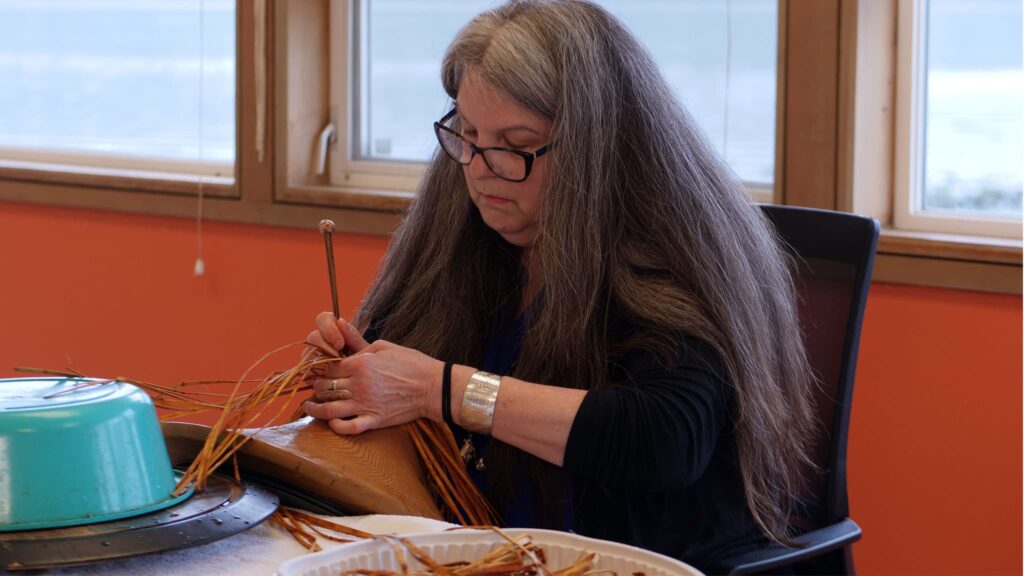
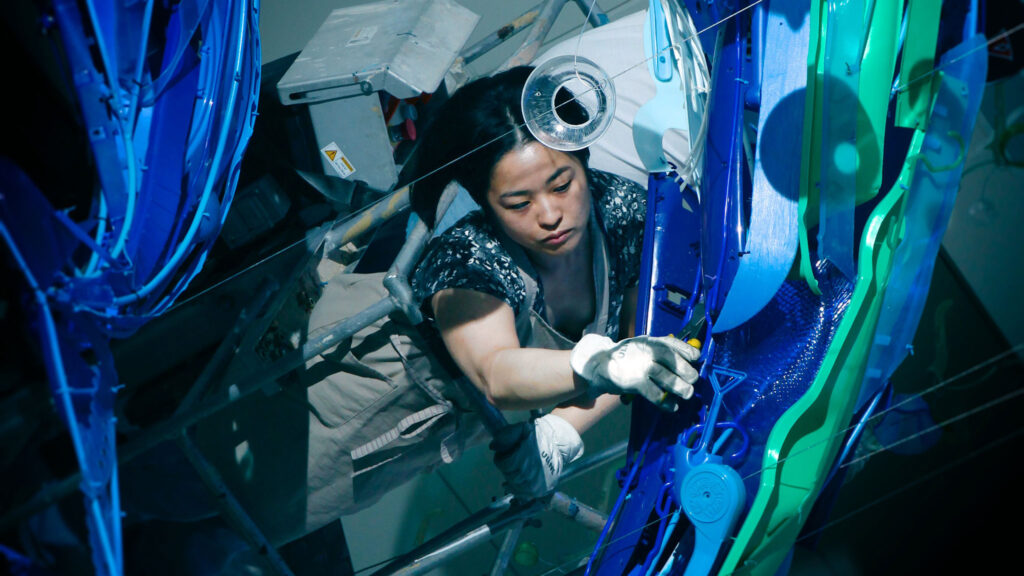
NORTH investigates the impact of the northern landscape on craft artists. Indigenous canoe practices, reclaimed materials, a craft school in the forest, and more demonstrate how natural and urban environments inspire the handmade in the Great North.
EPISODE HIGHLIGHTS
Eddington, Maine, is the home of Jeremy Frey, a basketmaker and recent recipient of the MacArthur Genius Grant. After learning traditional Passamaquoddy basketmaking, Jeremy’s innovations have made him one of the most notable contemporary basketmakers in the country.
Sayaka Ganz takes discarded plastics and metals and repurposes them into animal sculptures in Fort Wayne, Indiana. Inspired by her childhood growing up in Japan, Brazil, and Hong Kong, Sayaka creates complex sculptures of animals and sea creatures, giving new life to abandoned materials.
Returning to Maine, Deer Isle is the home of the Haystack Mountain School of Craft, operating for more than sixty years. This unique, remote craft school gives artists across all disciplines the opportunity to experiment, expand their creativity, and think deeply about what it means to make things, through workshops, classes, and residencies.
In Minneapolis, Minnesota, Tia Keobounpheng works as a fiber artist who weaves complex geometric patterns with thread on wooden canvas. Tia shows how she discovered that she was not just Finnish-American but Sami—the indigenous people of the far north of Norway, Sweden, Finland, and Russia—and brings her journey of self-discovery into her work, transforming her artistic practice.
In Washington state, Suquamish Elder Barbara Lawrence and her sons Nigel and Ian Lawrence tell the history of the Tribal Canoe Journey, an annual tradition that helped revive Native canoe culture in the Pacific Northwest. Black River Canoe Family skipper Willard Bill Jr. and his family take the viewer along the journey with them on the water, showing how the resurgence of Indigenous crafts and practices is impacting the community.
SOUTH
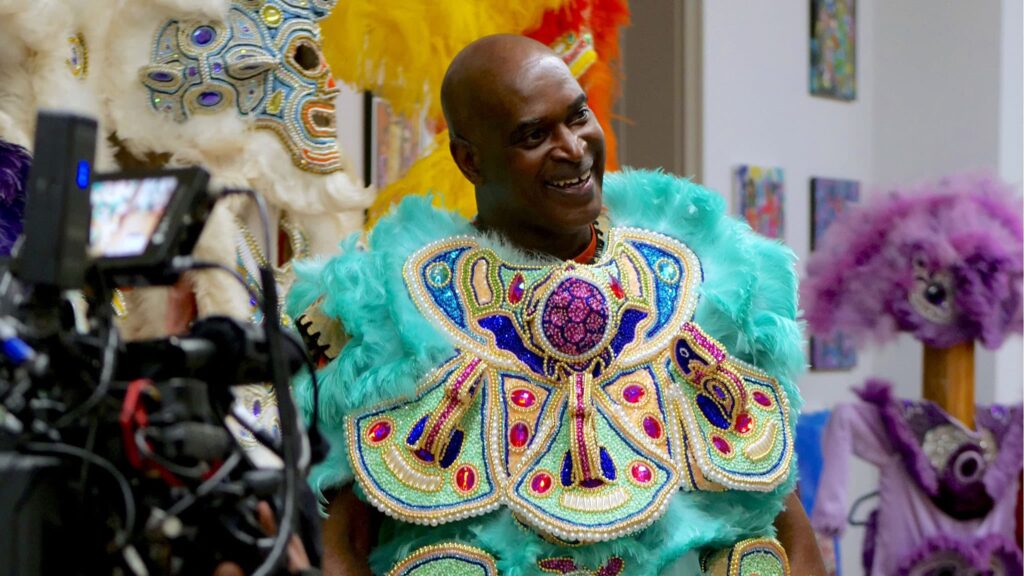
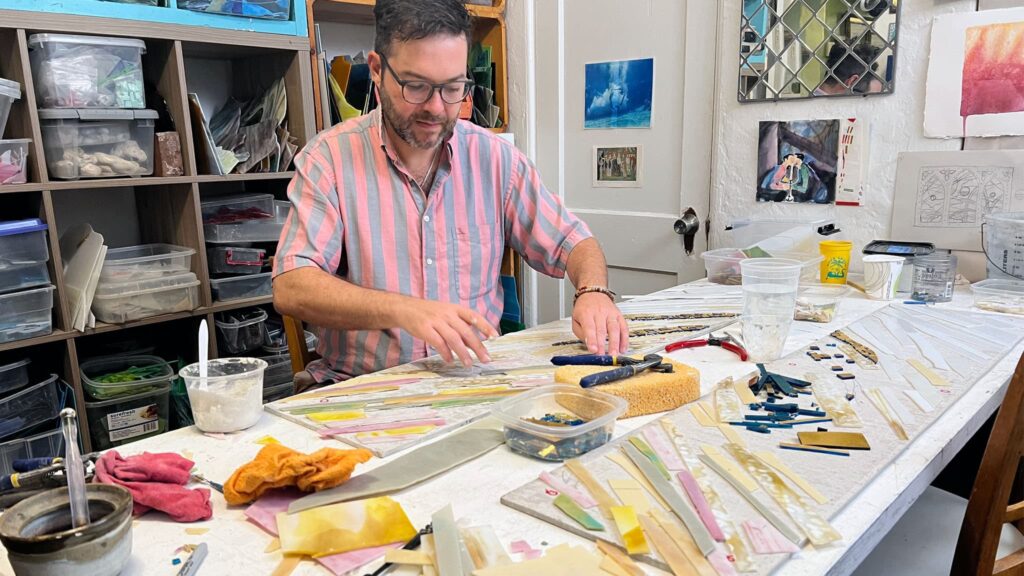
SOUTH explores craft artists who are building an inclusive and hopeful future. From elaborate costumes of New Orleans masking societies to mosaic stained glass in Miami and the vibrant artist community rebuilding after Hurricane Helene, the episode demonstrates the resilience and creativity of the American South.
EPISODE HIGHLIGHTS
In Atlanta, Georgia, Ato Ribeiro creates wooden quilt sculptures from repurposed wood, taking inspiration from his Ghanaian roots. He draws on African-American family legacy as well as Ghanaian culture in his work, referencing kente cloth, adinkra symbols, and Black American history.
The members of the Osceola-Zepeda family in Naples, Florida, are crafters who are preserving Seminole traditions and passing them down to the next generation. Karie, Jessica, and Marissa Osceola and Brian, Pedro, and Corinne Zepeda create patchwork clothes, sweetgrass baskets, beaded jewelry and bandolier bags, and dugout canoes in the Florida Everglades.
Spruce Pine, North Carolina, is the home of Vicki Essig, a fiber artist who raises hundreds of silkworms a year, painstakingly guiding them to spin fabric into patterns and construct wearable art garments with no thread or scissors. She uses her work to communicate important messages about equality and inclusion and to connect to the natural world of North Carolina, where Hurricane Helene devastated her community in 2024.
In Miami Beach, Florida, Sebastian Duncan-Portuondo is a stained glass mosaic artist whose work draws on his family’s Cuban heritage and his own queer identity. He shows his process, making a window, an art wall, a fireplace, and a collaborative community event memorializing the victims of the 2016 Pulse nightclub shooting.
Finally, the Ninth Ward of New Orleans during Mardi Gras is full of the traditional Black Masking societies, parading to show off the elaborate, three-dimensional costumes they make over the course of a year in an incredible 200-year-old tradition. Shaka Zulu of the Golden Feather Hunters and Edward Buckner of the Red Flame Hunters youth tribe show how they create beaded suits and connect to their communities.
CONTACT

This project is supported in part by an award from the National Endowment for the Arts.
To find out more about how National Endowment for the Arts grants impact individuals and communities, visit www.arts.gov.
Handwork 2026 has been made possible in part by the
National Endowment for the Humanities: Democracy demands wisdom.
Any views, findings, conclusions, or recommendations expressed in this program do not necessarily represent those of the National Endowment for the Humanities.
OUR MISSION
To promote and advance original handcrafted work through programs in all media
OUR GOALS
To document the importance of handmade objects and the artists who make them
To provide a gateway to discover, explore and experience craft
To celebrate our nation’s cultures through craft
CRAFT IN AMERICA, Inc. is a Los Angeles-based 501(c)(3) non-profit organization.
Charlotte’s Potters Market Set to Mark 20th Year With National Craft Spotlight
Hoodline Charlotte
By Avery Scott
9/26/26
North Carolina’s largest pottery sale is set to mark a milestone Saturday as the Potters Market at the Mint celebrates its 20th year on the front lawn of Mint Museum Randolph, with more than 55 top potters from across the state expected, along with live music, a beer garden, and pottery demonstrations for crowds paying $25 to get in.
The event, which ran from 9 a.m. to 4 p.m., is chaired by Betsy Wilder, according to Queen City News. Michele Huggins, the Mint Museum’s associate director of marketing and communications, also spoke to the outlet about the sale, which the museum bills as its signature annual ceramics fundraiser. That $25 general admission covered more than the lawn tent sale, too — it also granted full entry into the museum’s indoor art galleries, according to WDAV 89.9, which noted the day also included a beer garden and live bluegrass music.
This year’s market has extra significance beyond its location in Charlotte’s Eastover neighborhood. The 20th annual event is participating in Handwork 2026, a year-long national semiquincentennial initiative organized by Craft in America to celebrate craft traditions across the country, according to the Mint Museum. Museum President and CEO Dr. Todd Herman said in an August statement that the anniversary offers a chance to honor North Carolina’s ceramic legacy while introducing the state’s traditions to broader national audiences, per the museum.
A Star Juror and New Cash Prizes
Internationally acclaimed Pueblo ceramic artist Virgil Ortiz is scheduled to serve as awards juror at the Friday, Sept. 25, preview party and is scheduled to give a free public lecture Sunday. For the 20th anniversary, organizers also introduced enhanced cash awards for participating artists: a $3,000 Mellanay Delhom Award, a $2,000 Daisy Wade Bridges Award, a $1,000 Peggy and Bob Culbertson Best New Exhibitor Award, and a $500 People’s Choice Award, according to ZAPP. The Mellanay Delhom Award winner also receives automatic entry into next year’s market, per the same listing.
The market’s roots stretch back two decades. It was created in 2005, according to the museum. The Mint Museum acquired collector M. Mellanay Delhom’s extensive ceramics collection in 1965, according to the museum. The event is a juried show.
Traditional Craft Meets 3D Printing
Among the 55 juried artists displaying functional and conceptual ceramic works was UNC Charlotte art professor Thomas Schmidt, who uses a 3D clay printer to produce ceramic tiles for art commissions, as reported by The Charlotte Ledger. His work illustrates how local artists are pushing traditional clay methods in new technical directions even as the market celebrates its founding traditions.
Educational programming will extend the celebration beyond the market itself. A free public Potters Market Symposium is scheduled for Sunday, featuring a keynote lecture on North Carolina ceramics history from scholar Mark Hewitt, followed by a panel discussion with ceramic artists Cynthia Bringle, Travis Owens, and Ibrahim Said, according to the Decorative Arts Trust.
A Historic Setting in Eastover
The market’s backdrop carries its own history. Mint Museum Randolph, in Charlotte’s Eastover neighborhood, is the market’s setting.
The market aims to raise funds for the Mint Museum. Tickets were offered through the market’s website, Queen City News reported, making the 20th anniversary both a milestone celebration and a fundraiser for the Mint Museum.
Original article here.
San Diego exhibit explores what families pass down
AXIOS San Diego
By Claire Trageser
9/23/26
A new exhibit at the downtown library explores the idea of family through craft projects.
The big picture: “Becoming Heirlooms” uses work by local artists to explore the idea of inheritance and how heirlooms can be both a blessing and a burden.
Zoom in: The exhibit has sculptures including boxes and a tea set made by basketweaving from local artist India Thompson, which imply a potentially unwanted inheritance, according to KPBS.
Diana Benavídez made paper breasts smooshed between bricks to represent how breast cancer can be passed down in a family.
Phil Rowland created a wooden blanket chest with letters inlaid into the lid that read “Don’t Embarrass the Family.” It explores how family shapes what we carry forward, he told Axios.
The exhibit was curated by Kerianne Quick and Adam John Manley in conjunction with Handwork 2026, an initiative from the Craft in America museum in LA.
If you go, it’s open 1-7pm Tuesday, noon-5pm Wednesday to Friday, noon-4pm Saturday. Closed on Sundays and Mondays.
Original article here.
20th Century African American Quilts in California
SeeGreatArt.com
9/13/26
The National Museum of Women in the Arts (NMWA) presents an exhibition of more than 80 quilted objects traceing how Black women leaving the Jim Crow South stitched a legacy of survival, connection, and resilience across generations. On view from September 18, 2026, through January 17, 2027, Routed West: Twentieth-Century African American Quilts in California features works by more than 70 artists spanning 120 years. Exhibited on the East Coast for the first time, this must-see exhibition tells a uniquely American story through quilts from the Second Great Migration to today.
Organized by the Berkeley Art Museum and Pacific Film Archive (BAMPFA), where it debuted to strong acclaim in 2025, Routed West traces the flow and flourishing of quilts in the context of the Second Great Migration, a mass movement of approximately five million African Americans from the rural South to cities in the North and West between 1940 and 1970 in search of a more equitable life. Many of the hundreds of thousands who migrated to California carried quilts—not only for warmth and protection, but also as emblems of ancestral memory and cultural survival.
“Routed West threads the needle between Black people’s historical movements and their quilts to tell stories of collective care, resilience, and creative ingenuity,” NMWA curator Orin Zahra, who organized NMWA’s presentation of the exhibition, said. “Underscoring the individual, family, and community-based stories of these quilt-makers, Routed West embodies NMWA’s commitment to sharing lesser-known stories and counternarratives about artists whose contributions to American culture are profound. As featured artist Sherry Ann Byrd said, ‘Quilt-makers are among the female warriors of yesterday, today, and tomorrow.’”
The quilts reflect their creators’ artistic and technical brilliance, resourcefulness, and legacy. Employing expert skills and often using found materials, such as tobacco pouches, denim, and work clothes, they disrupted and blurred boundaries between “craft” and “fine art.” Routed West also reveals the artistic legacy of quilting, a living language shared across generations from matriarchs who lived through the Civil War and Emancipation to contemporary artists. These textiles are cherished heirlooms that honor ancestors, pass down technical expertise, and stitch family bonds.
“NMWA invites audiences to see these quilt-makers not at the margins of art history, but as essential figures in the story of American art,” NMWA Director Susan Fisher Sterling said. “Black women artists transformed cloth into a language of experimentation, memory, and visual power. Routed West also advances our goal to challenge and disrupt gendered hierarchies, by positioning fiber arts as equally significant to traditionally venerated genres such as painting and sculpture.”
Exhibition Overview
Routed West is organized within five thematic sections:
The quilts in Southern Roots highlight artistic approaches that reappear throughout the exhibition, such as the use of repurposed work clothes, improvisational piecing, pattern-based quilting, and tying. Hattie “Strawberry” Mitchell (1854–1942), one of the earliest quilt-makers in the exhibition, was born into slavery and spent her life laboring and working for white families. She quilted both for them and for personal use. After a transatlantic trip in 1906, Mitchell began working on a quilt of repeating green-and-red botanical forms patterned after leaves she collected while abroad, recording the locations of their origins with embroidery. Minnie Skinner (1920–2003) created a “britches quilt” in the late 1940s made of repurposed denim pieces, joining whole pant legs into a patchwork pattern.
Carried and Kept explores how quilts transcend their utilitarian purpose to become heirlooms and cherished objects. Many of the quilts in this section were brought to California by migrants from Arkansas, Louisiana, Mississippi, Oklahoma, and Texas. They offered literal and emotional protection, keeping them warm, preserving their southern roots, and anchoring their identity in a new landscape.
A hand-pieced quilt by Alice Neal (1916–1985) is a poignant tribute to her Louisiana-born mother, Mary Bright. Neal made the quilt in Oakland soon after her mother’s death in 1954, using leftover material from the dress Bright wore in the photo that inspired the quilt’s portrait. A replica of Bright’s hat snaps off to reveal a silk cap, and patterns carry personal meaning, such as the nine-block motif that was the first design Neal learned from her mother.
As teachers, nurses, seamstresses, truck drivers, grocery store managers, shipyard workers, and other members of a laboring class, artists in the section Rooted West used quilt-making to reclaim time for themselves, pursuing an activity that could be meditative, centering, and liberating. A 1991 quilt by Lily Chiles (1918–2000) features the continent of Africa and was created with her grandchildren. It affirms intergenerational care through a pan-African consciousness rooted in Oakland’s Black radical politics. As the elder quilter, Chiles guided her grandchildren in piecing and embroidering names of African countries onto the quilt. Isiadore Whitehead (1914–2005) was a school bus driver who quilted, and the school community donated fabric to help her create many projects, including the bedding, drapes, and pillows in an ambitious large-scale bedroom installation on view in the exhibition.
A variety of fabric choices also appear in quilts by Rosie Lee Tompkins (1936–2006), Johnnie Wade (1908–2015), Gussie Wells (1901–1994), and Arbie Williams (1916–2003), with the distinctive textures of satin, nylon, and polyester double knits offering novel alternatives to cotton. Tompkins sourced secondhand jeans to create distinctive blue-hued pillows, using denim as a way to reference her upbringing in rural Arkansas and memorialize her ancestors.
Tending Generations explores the relational dynamics of quilt-making by showcasing the work of multiple generations within families, demonstrating how African American quilt-making strengthens and nurtures the bonds between women, celebrating their wisdom and imaginative potential. Sisters Beauty Vaughns (1911–2005) and Arbie Major (1915–2013) learned technical skills of piecing from their seamstress mother, Pearl Nunley (1888–1952). Vaughns’s Ocean Wave-patterned quilt(1963) and Major’s Snowball string quilt (ca. 1950–52) both demonstrate the meticulous and repetitive process of measuring, cutting, arranging, piecing, composing, and stitching. Together with Nunley and Vaughn’s Flower Garden (Sunflower variation) (1940), these quilts underscore a powerful lineage of African American women’s labor, creativity, and ingenuity.
Another family of quilters includes Gladys Durham-Henry (1906–1996), her daughter Laverne Brackens (b. 1927), granddaughter Sherry Ann Byrd, and great-granddaughter, Bara Byrd-Stewart (b. 1975). Byrd’s playful improvisation of orange, yellow, red, and blue stripes in Cultural Merger at Crossroads, USA (1990) echoes the lively rhythm of free jazz.
In the decades since 1980, roughly two dozen African American quilt guilds have been founded throughout the United States. As a coda to the exhibition’s historical narrative, A Living Tradition features works by contemporary artists and collectives who are keeping traditions of African American quilting alive today. United We Win! (2024), a vibrant narrative quilt from a larger quilt project on the history of the Hunters Point Shipyard by Stacey Carter (b. 1969) and William Rhodes (b. 1966), was made in collaboration with African American who were employed at the shipyard during World War II and afterward. The series exemplifies the persistent power of quilt-making as a forceful language for elevating stories of Black life in California. Education’s Promise (2025), by Niambi Clay (b. 1951), was inspired by a work from Jacob Lawrence’s iconic Migration Series in which three African American girls write on a chalkboard. Clay’s work addresses civil rights setbacks of the Second Great Migration, as well as present-day oppression and harsh realities.
Routed West is drawn from quilts from the African American Quilt Collection at BAMPFA, the largest collection of its kind, and contemporary work from the Bay Area. The exhibition’s presentation at NMWA is part of the museum’s multifaceted participation in Handwork: Celebrating American Craft 2026, an initiative of Craft in America.
About BAMPFA
Berkeley Art Museum and Pacific Film Archive (BAMPFA) ignites cultural change for a more inclusive and artistic world. BAMPFA has been uniquely dedicated to art and film since 1970, with international programming that is locally connected and globally relevant. It holds more than 25,000 artworks and 18,000 films and videos in its collection, with particular strengths in modern and contemporary art and historical Chinese painting, as well as the world’s largest collection of African American quilts.
As part of the University of California, Berkeley, BAMPFA is committed to artistic diversity through its robust slate of art exhibitions, film screenings, artist talks, live performances, and educational programs that shed new light on the art of the past and connect audiences with leading filmmakers and artists of our time.
National Museum of Women in the Arts
The National Museum of Women in the Arts (NMWA) is the first museum in the world solely dedicated to championing women through the arts. With its collections, exhibitions, programs, and online content, the museum inspires dynamic exchanges about art and ideas. NMWA advocates for better representation of women and nonbinary artists and serves as a vital center for thought leadership, community engagement and social change. NMWA addresses the gender imbalance in the presentation of art by bringing to light important women artists of the past while promoting great women artists working today.
The collection highlights a wide range of works in a variety of mediums by artists including Rosa Bonheur, Louise Bourgeois, Lalla Essaydi, Lavinia Fontana, Frida Kahlo, Hung Liu, Zanele Muholi, Faith Ringgold, Niki de Saint Phalle, and Amy Sherald.
NMWA is located at 1250 New York Avenue, NW, Washington, D.C. It is open Tues.–Sun., 10 a.m.–5 p.m., and closed on Mondays and select holidays.
Admission is $16 for adults; $13 for D.C. residents, visitors 65 and over, students and educators, active-duty military and veterans, and visitors with a Native/Tribal Affiliation; and free for visitors 21 and under, visitors with disabilities, and SNAP/EBT card holders. Admission is free the first Sunday and second Wednesday of each month.
For information, call 202-783-5000, visit nmwa.org