POSTS
CraftForms 2026, 31st International Juried Exhibition of Contemporary Fine Craft
EXHIBITIONS
CraftForms 2026, 31st International Juried Exhibition of Contemporary Fine Craft
December 6, 2026 – January 23, 2027
Entry Deadline: September 9 · Entry Information
Wayne Art Center is seeking submissions for CraftForms 2026, the 31st International Juried Exhibition of Contemporary Fine Craft, in the following mediums: basketry, ceramics, fiber, furniture, glass, jewelry, metal, mixed media, paper, wearable art, and wood. Works created utilizing CAD/CAM technologies and 3D printing tools are also eligible. Selected works will be on display in the Davenport Gallery of Wayne Art Center in Wayne, Pennsylvania from December 6, 2026 through January 23, 2027. This year’s Jurors, Dr. Robert K. Liu and Patrick Benesh-Liu of Ornament Magazine will present $12,000+ in prize awards funded by Wayne Art Center.
For more information, visit www.craftforms.org
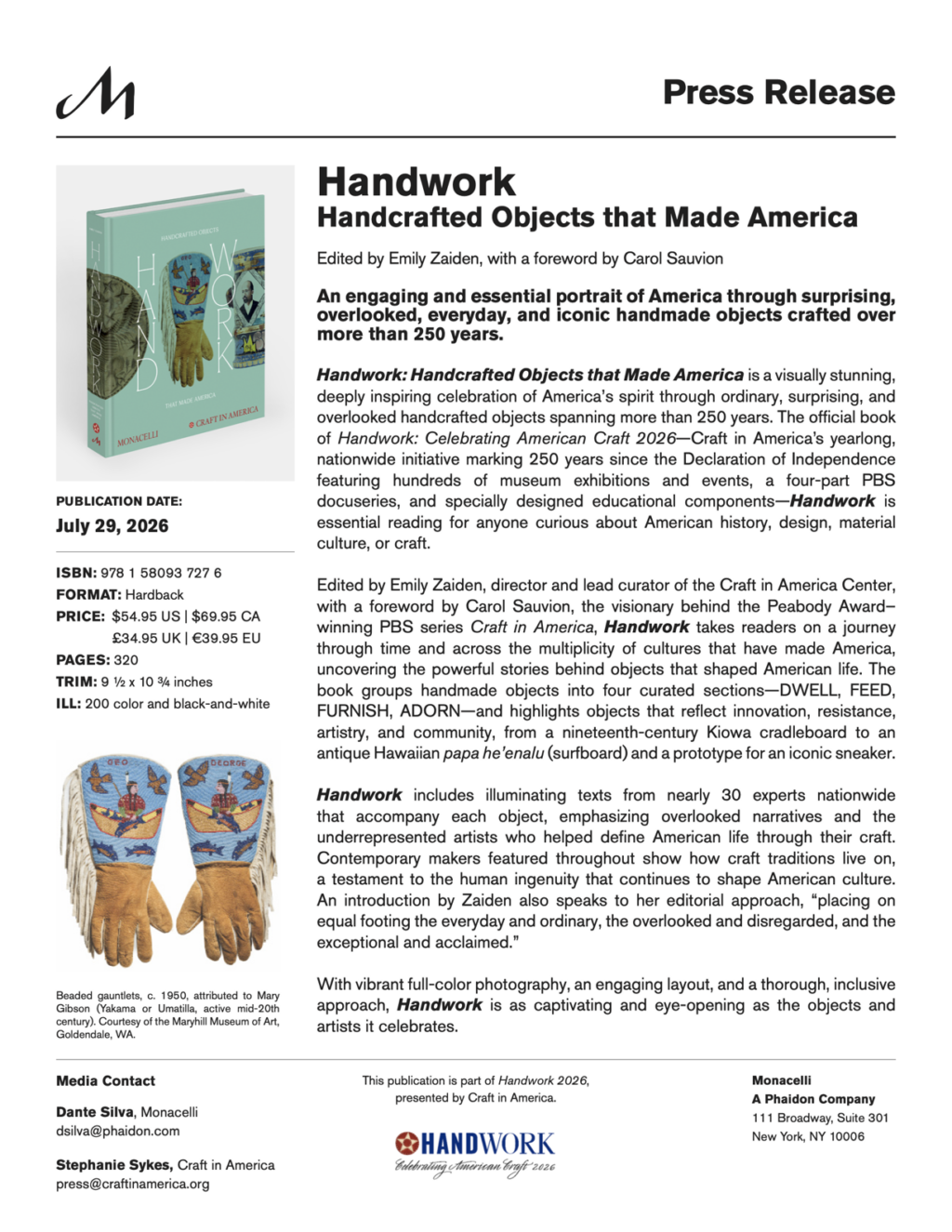
COMING JULY 29 | Handwork: Handcrafted Objects that Made America
Florida CraftArt Statewide Craft Conversation
5/12/26
Florida CraftArt is bringing makers, arts organizations, educators, and supporters together for a statewide conversation—and we’d love for you to be part of it.
This virtual gathering is designed to spark connections, share ideas, and strengthen the network of people and organizations championing craft across Florida. It’s an opportunity to learn from each other, promote what’s happening in your corner of the state, and explore ways we can collaborate.
As part of Florida CraftArt’s 75th Anniversary and our participation in Handwork 2026, we have been celebrating with two exhibitions: The Makers That Made Us, which recently closed and reflected on the artists and moments that have shaped our history, and Florida NOW (on view through June 13), a look at contemporary craft across the state.
Agenda:
Welcome & Overview– A brief introduction to Florida CraftArt, our 75th Anniversary, and the purpose of this statewide initiative.
Florida NOW: Artists in Conversation– Moderated by Holly Hanessian, curator of Florida NOW and recently retired Head of Ceramics at Florida State University, this conversation will feature Wendy Bruce (fiber artist exploring structure and process), Cheri Dunnigan (metalsmith creating finely crafted silver work that explores form and surface), and Marty Fielding (ceramic artist focused on form and material), discussing their work and the current craft landscape. Presentation includes Q&A.
Spotlight on the Florida School of Woodwork– The Florida School of Woodwork is a Tampa-based woodworking school and creative community where nationally recognized makers, local instructors, and students of all skill levels come together in a historic workshop dedicated to the craft of woodworking, where thinking and doing meet. Meighan Hornaday, President of the School, will share updates on current programs, offer insight into the School’s approach to hands-on craft education, and give a sense of what’s ahead.
Open Discussion– An open floor for attendees to promote events, share opportunities, and bring forward ideas or issues for discussion. You might want to share:
Upcoming exhibitions, workshops, or calls for artists
Opportunities for collaboration or resource sharing
Community art initiatives or success stories
Challenges you’re facing and creative solutions
Questions for fellow artists and arts leaders
Whether you’re a craft artist, a representative from an arts organization, an educator, or simply a passionate supporter of fine craft, your voice is welcome in the conversation.
Let’s connect, inspire, and work together to keep Florida’s craft community vibrant and strong.
San Diego weekend arts top picks: Farmworker portraits, cello and a twist on ‘Hamlet’
May 7th, 2026
‘The Natural World’
A new group exhibition at The Studio Door is part of Craft in America’s “Handwork: Celebrating American Craft 2026” semiquincentennial programming. Curated by Laura Green and Pierre Bounaud, the exhibit includes painting and sculpture that explore the natural world by artists Caroline Blackburn, Ellen Dieter, Kathleen Kane-Murrell, Oscar Romo and Kazuki Takizawa. A reception will be held next Saturday, May 16.
May 8 – June 12 | The Studio Door, 3867 Fourth Ave., Hillcrest | Free | MORE INFO
True Gravity
May 7th, 2026
March 27, 2026 – March 10, 2027
Luminous forms welcome visitors to The Rockwell Museum, a Smithsonian Affiliate, in True Gravity, the latest installation in its Antigravity series. Created by neon artists and founders of She Bends Studios, the installation was designed by Kelsey Issel in collaborative mentorship with Meryl Pataky. The work will be on view through March 2027 in the first-floor entryway. Suspended within the Museum’s historic rotunda, the installation explores glass, light and the subtle forces that shape form.
She Bends is a neon organization and teaching studio dedicated to the practice and study of neon craft and contemporary art, highlighting the contributions of women and gender-expansive artists who bend their own glass and push the boundaries of the material.
“True Gravity is a study in balance: breath, heat and gravity conspiring with two artists to make something suspended between intent and inevitability—a record of trust in each other, in the material and in the invisible forces, human and natural, that hold us here,” said Issel.
Drawing from the visual and structural language of open weave textiles, True Gravity examines tensions between rigidity and flexibility and individuality and interdependence. Pataky and Issel’s neon creations invite visitors to reconsider the expressive potential of glass and light. Weighing more than 100 pounds, the soft glass tubes are filled with krypton, creating an ethereal milky white color suspended by monofilament.
The title of the work of art references Michael Murphy’s concept of “true gravity,” a condition in which the body yields to what the material and the environment already intend. The artists’ shared practice draws on feminist teaching methods, valuing attunement over control and exchange over hierarchy.
The presentation of “True Gravity” also supports America 250 as The Rockwell Museum’s contribution to “Handwork: Celebrating American Craft 2026,” a nationwide initiative led by Craft in America. The yearlong effort brings together makers, museums and cultural organizations to celebrate the craft traditions that connect communities across the country.
“During this year of celebrating American craft, the installation sets the tone for every visit to The Rockwell,” said Erin M. Coe, executive director of The Rockwell Museum. “True Gravity captures the experimentation at the heart of the Museum’s Antigravity projects, and Kelsey and Meryl’s boundary‑pushing neon offers a memorable and surprising experience for our visitors.”
Now in its eighth year, Antigravity is an ongoing series of site-specific installations in the entry of The Rockwell Museum. The program highlights emerging artists and invites them to create original, thought-provoking work in an unexpected space that greets every visitor. As the first artwork guests encounter, each installation is designed to be fun, surprising and engaging.
A key component of the Antigravity project is the Museum’s collaboration with the Corning Museum of Glass. Antigravity artists are invited to serve as guest designers in residence at the Amphitheater Hot Shop, where they work alongside expert glassblowers who help translate their ideas into glass. Pataky and Issel participated in this residency, using the opportunity to experiment with hot glassmaking techniques outside of their usual realm of work.
True Gravity is part of “Reframed at 50,” The Rockwell’s yearlong series of dynamic exhibitions and programs commemorating the institution’s 50th anniversary. The installation also coincides with the 2026 Glass Art Society Conference and the 75th anniversary of the Corning Museum of Glass.
Image: Kelsey Issel and Meryl Pataky, True Gravity, 2026. 8mm hand bent clear soda-lime glass tubes filled with Krypton gas, electronic transformers. Final installation at The Rockwell Museum, Corning, NY. Photograph by Andrew Owen.
Celebrate Women Artists throughout America 250 at the National Museum of Women in the Arts
May 6th, 2026
Washington, D.C.—As the United States marks the 250th anniversary of the signing of the Declaration of Independence, the National Museum of Women in the Arts (NMWA) celebrates women who have shaped its art history and cultural life. The year-long opportunity for discovery encompasses a series of exhibitions showcasing the work of American women artists across centuries and disciplines, underscoring women’s vital—yet historically underrecognized—role in the arts.
Coinciding with cultural events nationwide and at landmark destinations across Washington, D.C., NMWA presents a series of exhibitions and installations that offer diverse perspectives on American women’s artistic production across regions, communities, and generations.
“This milestone anniversary invites us to reconsider the story of American art and to recognize the women who have shaped it in essential ways,” said NMWA director Susan Fisher Sterling. “Our mission has always been about expanding the canon of art history and advocating for gender equity. When artists of all genders, identities, and backgrounds are included in the celebration of our nation’s 250th anniversary, we provide a more complete and compelling picture of our shared cultural history that we can be justly proud of.”
Highlights include Ms. Americana, an installation of 10 historical paintings by American women artists from the 18th to 20th centuries; Burnished: Pueblo Pottery at NMWA, an exhibition of Pueblo pottery from the American Southwest; and Routed West: Twentieth-Century African American Quilts in California, which traces the flow and flourishing of quilts in the context of the Second Great Migration. Several solo exhibitions throughout the year showcase American artists such as Ruth Orkin (1921–1985), Tawny Chatmon (b.1979), Shirley Gorelick (1924–2000), Marlo Pascual (1972–2020), and Beverly Pepper (1922–2020). Works by many notable American artists are also featured Making Their Mark: Works from the Shah Garg Collection, a global exhibition of women who shaped abstraction. NMWA’s diverse, thematically arranged collection installation provides even more opportunities for discovery of American artists. Details on related exhibitions are included below.
Founded with a dual purpose of exhibition and advocacy, NMWA is committed to
confronting historical and contemporary gender equity in the arts. Opportunities for education and action are offered throughout ongoing campaigns such as #5WomenArtists and Random Acts of Art Equity, as well as in programs for all ages. The museum’s beautiful neoclassical building, built in 1908 as a Masonic Temple and transformed into a beacon for art and diversity when NMWA opened to the public in 1987, is a true D.C. landmark.
Ms. Americana
April 3 to October 31, 2027
On view in NMWA’s Great Hall, Ms. Americana features a selection of historical works by American women artists from the collection. The installation features 10 still lifes, portraits, and landscapes spanning the 18th to 20th centuries by nine American women artists: Jennie Augusta Brownscombe, Cecilia Beaux, Ellen Day Hale, Clementine Hunter, Lilla Cabot Perry, Sarah Miriam Peale, Anna Claypoole Peale, Jane Peterson, and Lilly Martin Spencer. Collectively, these works embody the “Americana” aesthetic, evoking the nation’s history and nostalgia for the past. Yet the women behind the paintings pursued their own independence and personal enlightenment. They traveled the world, ran their own businesses, and actively engaged politicians and heads of state. The installation is an extension of the museum’s thematic collection galleries.
Burnished: Pueblo Pottery at NMWA
May 8 to September 27, 2026
For more than two millennia, Pueblo potters living in the southwestern region of North America have created clay jars and bowls for storage and ceremonial purposes. Women are at the forefront of this work, imparting their knowledge and skills to family members. Burnished: Pueblo Pottery at NMWA presents 24 elegantly shaped clay ollas (vessels historically used for water storage and gardening), seed jars and bowls that are drawn from the museum’s groundbreaking—and growing—collection. These vessels reflect diverse traditions across Pueblo communities. Featured artists include San Ildefonso potter Maria Martinez (1887–1980); Santa Clara artists Margaret Tafoya (1904–2001) and Stephanie Tafoya (b. 1991); Acoma potters Emma Lewis-Mitchell (1931–2013) and Dorothy Torivio (1946–2011); and Hopi-Tewa artist Iris Youvella Nampeyo (1944–2018), among many others. The exhibition is part of the NMWA’s participation in Handwork: Celebrating American Craft 2026, an initiative of Craft in America.
Marlo Pascual
July 24, 2026 to February 28, 2027
Visionary artist Marlo Pascual (1972–2020) created objects that amuse, confuse, and provoke viewers by dramatically recontextualizing anonymous vintage photographs and found objects. Featuring seventeen works that she made between 2009 and 2014, the exhibition demonstrates the artist’s methods of transforming and recontextualizing her thrift-store source material through enlargement, fragmentation, obfuscation, and the addition of external elements. Pascual was born in Tennessee and educated at Philadelphia’s Tyler School of Art. Her work is now held in museum collections across the U.S., including the Aspen Art Museum, Colorado; the Museum of Contemporary Art Chicago; the Walker Art Center, Minneapolis; the Pérez Art Museum Miami; and the Whitney Museum of American Art, New York. This is the first solo museum exhibition of Pascual’s work since the artist died of ovarian cancer at the age of 48.
Routed West: Twentieth-Century African American Quilts in California
September 18, 2026 to January 17, 2027
Routed West: Twentieth-Century African American Quilts in California traces the flow and flourishing of quilts in the context of the Second Great Migration, a mass movement of five million African Americans from the rural South to cities in the North and West between 1940 and 1970 in search of a more equitable life. Many of the hundreds of thousands of migrants who arrived in California carried quilts for warmth and protection, as well as emblems of ancestral memory and Black cultural survival. Through more than 80 artworks, Routed West reflects a joyful expression of history, craft, and stories of community, heritage, and resilience. The exhibition is organized by the Berkeley Art Museum and Pacific Film Archive and curated by Elaine Y. Yau, Associate Curator and Academic Liaison, with Matthew Villar Miranda, Former Curatorial Associate. The exhibition is part of NMWA’s participation in Handwork: Celebrating American Craft 2026, an initiative of Craft in America.
Beverly Pepper: Earthworks
October 24, 2026–April 25, 2027
NMWA will present a spotlight exhibition of work by Beverly Pepper, an acclaimed American sculptor known for monumental abstract and geometric works in Cor-ten steel and iron. Cor-ten, a trademarked steel alloy, is a famously dramatic and weather resistant material that Pepper helped pioneer for sculptural use in the early 1970s. Challenging the perception of such work as the purview only of men, Pepper was ambitious, creating bold large-scale works by adapting rugged material into an evolving series of powerfully expressive sculptures. Beverly Pepper: Earthworks will include a film highlighting the global reach of Pepper’s land and architectural-scale works, paired with several smaller sculptures and maquettes.
Making Their Mark: Works from the Shah Garg Collection
Through July 26, 2026
Making Their Mark: Works from the Shah Garg Collection illustrates women artists’ vital role in abstraction, showcasing work by some of the most important artists of the 20th and 21st centuries. The exhibition considers historical contributions, formal and material breakthroughs, and intergenerational relationships among women artists over the last eight decades. Sculptures, paintings, textiles, ceramics, prints and mixed-media works present a rich and interwoven picture of contemporary art history. Of the 80 works by 68 artists featured in the show, many are by artists from or based in the U.S., including Andrea Bowers, Sheila Hicks, Jenny Holzer, Julie Mehretu, Joan Mitchell, Howardena Pindell, Faith Ringgold, Tschabalala Self, Lorna Simpson, Pat Steir, and Jaune Quick-to-See Smith, among many others.
Shirley Gorelick: Figuring It Out
Through June 28, 2026
Through the 1960s and 1970s, Shirley Gorelick (1924–2000) created soulful portrayals of her circle of close friends. Nearly 40 paintings, drawings, and prints by the artist reveal her bold realist style, which combines vigorous brushwork, heightened shadows, and vivid patterns. Gorelick’s partnerships in the 1970s with New York’s pioneering women-run galleries position her as an inspiring feminist role model. The exhibition centers on three large-scale paintings in NMWA’s collection, which are exhibited together for the first time.
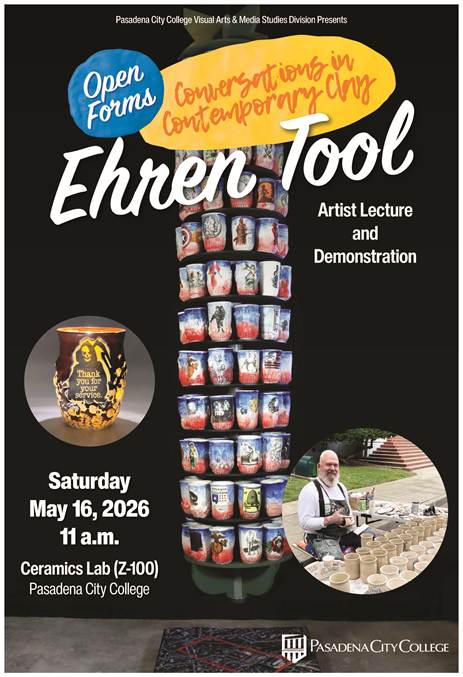
Ehren Tool Lecture & Demonstration at Pasadena City College
Local artists shine in new Florida NOW exhibition, on display in Downtown St. Pete
May 5, 2026
By Courtney Dodson
There’s no better time to check out Florida’s contemporary craft scene than now, and Florida NOW takes that idea seriously. Opening at Florida CraftArt (501 Central Ave) in downtown St. Pete, this new exhibit brings together artists from across the state who are rethinking traditional materials in thoughtful, imaginative, and sometimes surprising ways.
The opening reception takes place Saturday, May 9, from 6-8 pm, and it’s the ideal excuse to stop by Florida CraftArt, mingle with the local arts community, and get the first look at a show that blends impressive craftsmanship with ideas that speak to the present.
Traditional materials, contemporary ideas
Curated by Holly Hanessian, a nationally respected artist and longtime ceramics educator, Florida NOW highlights the wide range of fine craft being made across Florida today. The exhibition spans everything from sculptural ceramics and glass art to fiber, metal, and wood—all rooted in traditional techniques but showcasing current perspectives.
Artists are featured from around the state (from Tampa Bay to Miami to Tallahassee), offering a snapshot of a diverse and deeply creative craft community. Personal stories, social reflections, and Florida’s unique culture and landscape show up again and again, shaping work that feels grounded, intentional, and rooted in real experience.
A show that feels right on time
Florida NOW is part of Florida CraftArt’s 75th anniversary programming and is part of Handwork 2026, a nationwide program that explores the cultural impact of craft in America. But this exhibition doesn’t feel like a history lesson. Instead, it stays focused on the present, highlighting how established techniques continue to evolve along with new technologies, environmental concerns, and life experience.
Throughout the gallery, artists use their materials to tell stories—sometimes poetic and sometimes pointed. The show feels thoughtful without being heavy, encouraging visitors to pause, look closely, and appreciate the care behind each piece.
Mark your calendar (and bring a friend!)
Florida NOW is on view through June 13, but opening night is worth circling on your calendar. The May 9 reception brings together artists and the local arts community for a relaxed, welcoming evening where visitors can ask questions, connect, and learn something new.
Can’t make opening night? There’s plenty of time to catch the exhibit during regular gallery hours, Monday through Saturday from 10 am to 5:30 pm, and Sundays from 12 to 5 pm. For more information, visit Florida CraftArt’s website or check out the Facebook event page.
American Swedish Institute’s Cultivating Nordic Craft: Teaching Tools Grant
This application is currently open through May 25, 2026.
This grant provides a one-time award of up to $1,000 worth of tools and equipment to expand the teaching capacity for an emerging craft instructor. This grant aims to cultivate craft education in the Swedish slöjd (handcraft) tradition by investing in the next generation of craft practitioners and instructors. ASI believes that investing in individual instructors is an important way to preserve Nordic handcraft traditions and create innovation in the handcraft community, because it allows instructors to gain experience and share knowledge while increasing their capacity to teach widely across many institutions.
The strongest applicants will have several years of teaching experience, will address the viability of creating a long term and potentially varied teaching curriculum with such teaching tools, will enable the instructor to teach a full-size class (usually 6-15 students), and will demonstrate teaching relationships with several institutions. It is assumed and encouraged that awardees will use their awarded teaching tools for teaching opportunities beyond ASI.
Read the full grant description here and apply here.
For more information, please email Erin Swenson-Klatt, ASI Cultural Programs Manager.
Elysian Valley skateboard brand lands in L.A. art exhibit
By Brenda Rees
May 1, 2026
Elysian Valley—When it first happened, Ryan Anderson wasn’t fazed. But when people kept grabbing his DIY skateboard at coffee shops and other spots, marveling at the dozens of circular holes on the deck and wanting to try it, Anderson realized he was on to something.
A decade later, Anderson and partner Russell Hill at Rad Furniture have a famous skateboarding brand on their resume—one that’s literally gallery worthy.
Anderson and Hill grew up in 1980s San Diego as part of the skateboarding and BMX scene, and they founded Rad in Austin, Texas. When they moved their furniture manufacturing business back to LA in 2015 and to Frogtown in 2017, they decided to reconnect with their California roots. So they fashioned a skateboard from a piece of scrap metal.
“It was just intended to be fun, but people really responded to it,” Anderson said. “The attention caught us by surprise.”
The challenge became turning that rough prototype into a product. To make the material more environmentally friendly, they moved from metal to repurposed nylon fishing line. It was injected into the grooves of an iconic skateboard shape, but with an airy, perforated, lightweight twist.
The boards, under the Rad spinoff Lander, are sold worldwide through skate shops and online. In addition to being purchased by fans for decks at $75 and complete sets at $145, they are included in a new exhibit at Craft in America in L.A.’s Beverly Grove neighborhood. The art gallery show “Vehicles of Expression: The Craft of the Skateboard” chronicles how skateboarding evolved from its Southern California DIY roots, which offer clever innovations and artistic interpretations. The show runs until the end of May.
Anderson calls the exhibit the “perfect venue” to tell the story of their skateboard. On display is that first board, welded in 2015, and later prototypes showing the growth of the line.
Anderson thinks even non-skaters will appreciate the exhibit.
“There’s a lot to respect about the craft and ability to skateboard,” he said. “You can be standing up one second and on your back the next. That coolness will never go away—and being on a skateboard is the easiest way to feel like a kid again.”
Original article here.